2:36


Waybill - Take your supply chain for granted.
Waybill · B2B · Aug 2026
Phylo · Nov 2026 · 1:26 · Full motion · AI-annotated
Phylo’s 1:26 launch film runs 31 scenes, about 2.8 s each. The product is on screen from the first frame and 3 features are revealed. The call to action lands at 1:21 (94% in). The video is built as a calm, text-led explainer on a flat cream field: a serif headline with a lime highlighter swipe names each beat, while a particle swarm and small line-drawn UI cards assemble, count up, and dissolve in slow, even cuts. Pacing is steady and unhurried, with the recurring three-card feature menu acting as a compass that zooms into each use case and pulls back, giving the whole piece a quiet, scientific, diagrammatic identity.
Is this your launch? to your site or press kit.
Waybill · B2B · Aug 2026
Memoir · B2B · Jun 2026
Films whose music sounds like this one, voice left out
Microsoft · Modern electronic pop, funk, and lo-fi hip-hop
Hebbia · Electronic dance music
Probo · Lo-fi hip-hop and electronic dance music
Small dark dots drift in two loose clusters on a cream field, then settle around the centered serif title over a pale yellow-green blob, and the letters dissolve back into the swarm.
On-screen text: “Biomni Swarm”
Techniques: Particles
Camera: Pull out
A cream field holds a line of dark serif text that fades in. A yellow-green highlighter swipe marks the word “thousands.” The line then blurs out and a larger second line fades in, centered.
On-screen text: “Direct thousands of virtual autonomous scientists”, “for your most ambitious research questions.”
Techniques: Kinetic type
Camera: Static
A centered serif tagline sits on a cream background, then fades out as a small round lime badge with the brand name scales in at the center.
On-screen text: “for your most ambitious research questions.”
Camera: Static
A yellow Biomni badge holds center on a cream field as the caption counts agents from 46 to 1,000. A swarm of grey dots assembles into a dense oval around it, then the dots take on yellow rims and thin lines connect them into a network.
On-screen text: “46 agents”, “Each one takes its own piece of the question.”, “1,000 agents”, “A shared message board”, “Agents communicate and collaborate with each other.”
Techniques: Particles
Camera: Static
A yellow Biomni badge sits at the center of an oval dot field on a cream background. Thin lines link the dots into a web, then the lines and the headline above fade out, leaving the plain dot grid.
On-screen text: “A shared message board”, “Agents communicate and collaborate with each other.”
Camera: Static
A disc of small dots swirls slowly around a yellow Biomni badge. Tiny squares drift down from the cloud into a shared filesystem grid at the bottom, filling its slots row by row. The headline and panel fade out at the end.
On-screen text: “A shared filesystem”, “Every agent builds on what the others have written.”
Techniques: Particles
Camera: Static
A cream backdrop holds the headline 'Compute at scale' over a rotating disk of gray and olive dots with a yellow-green Biomni logo at the center. Below, a row of small squares fills in under the caption '2,000 CPU AND GPU MACHINES,' then the frame fades out.
On-screen text: “Compute at scale”, “Each agent can already process a lot of data. Now multiply that by thousands.”, “2,000 CPU AND GPU MACHINES”, “A shared filesystem”, “Every agent builds on what the others have written.”
Techniques: Particles
Camera: Static
An empty prompt bar on a cream background types a medical question as a caption fades in below. The view then zooms in while the cursor opens a dropdown listing Auto and Swarm options with toggles.
On-screen text: “I run your analysis on autoscaling machines.”
Techniques: UI zoom, Cursor demo
Camera: Push in
A settings card lists two rows, Auto and Swarm Beta. A cursor clicks the Swarm toggle, which turns green with a short ripple, while the Auto toggle stays gray. The card sits on a plain light background.
Techniques: Cursor demo
Camera: Static
A close-up of a settings card on a cream background shows Auto and Swarm toggles, then the card scales down and recenters to display a Main agent row with a yellow dot and a task label.
Techniques: UI zoom
Camera: Static
A serif headline sits above a schematic diagram. The Main agent card links by a dashed line to a Setup card, whose progress bar fills; then a GENERATION column of task cards fades in on the right as curved dashed lines connect them.
On-screen text: “The parent agent plans the work”
Camera: Pull out
A flowchart on a cream background assembles: a Main agent card links to a Setup card, which fans out via dashed lines to five hypothesis cards whose progress bars fill. A Merge card appears on the right and the count updates from 5 to 7 sub-agents.
On-screen text: “Agents work in parallel”
Camera: Static
A flat node graph on a cream background, the camera zooms and pans right to reframe onto a Reflection group of three cards and a single Evolve card. Dashed lines connect the cards, which slide gently into position.
Techniques: UI zoom
Camera: Pan
A cream background holds a horizontal flowchart of rounded boxes (Tournament, Evolve, Reviewer C, Reviewer D, Report) linked by dashed lines, building from left to right. A serif headline fades in at the top with a yellow-green highlight over 'reviewed and refined', then fades out.
On-screen text: “Ideas get reviewed and refined”
Techniques: Kinetic type
Camera: Static
A locked-off shot holds a process flowchart on a cream field. Dashed lines link four dark-outlined boxes, Tournament, Evolve, a Reflection panel holding Reviewer C and Reviewer D, and Report, with a looping arrow marked More rounds.
Camera: Static
A white report card with a title, summary line and four stat boxes settles under a serif headline as a ghosted double of it dissolves; faded ranking and reviewer panels behind it fade out, leaving a plain cream field.
On-screen text: “Results come back as one report”
Camera: Static
On a cream background, the headline fades in at top center, then three outlined cards appear left to right, each holding a small icon (a curve, a node network, a square grid) above a label. The cards fade in and hold still.
On-screen text: “Science at swarm scale”, “Scientific model training”, “Massive data curation”, “Open-ended hypothesis generation”
Camera: Static
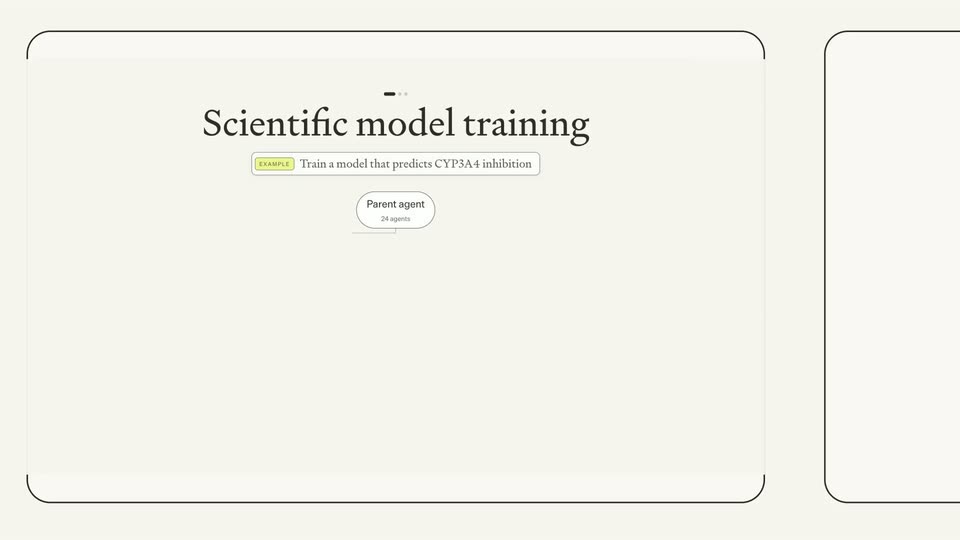
A cream card titled “Scientific model training” shows an example prompt and a “Parent agent” node that spawns a downward tree of green dots. The view then zooms out to reveal a wider “Science at swarm scale” panel holding three labeled cards.
On-screen text: “Scientific model training”, “EXAMPLE: Train a model that predicts CYP3A4 inhibition”, “Parent agent”, “24 agents”, “Science at swarm scale”, “Massive data curation”, “Open-ended hypothesis generation”
Techniques: Kinetic type, UI zoom
Camera: Push in
A cream slide titled in black serif reads Scientific model training above a bordered EXAMPLE caption. Below, a tree diagram animates: the Parent agent node scales in, then columns of green dots grow row by row while pale rounded cards fade in beside them.
On-screen text: “Scientific model training”, “EXAMPLE”, “Train a model that predicts CYP3A4 inhibition”, “Parent agent”, “24 agents”
Camera: Static
A 24-card grid of model names with small line charts and scores fills in as the charts draw and numbers count up, the best AUROC ticks to 0.88, and the top three cards get green outlines. The grid then swaps to a Round 2 set of combination cards while the lime step caption below cycles through the four steps.
On-screen text: “Scientific model training”, “EXAMPLE Train a model that predicts CYP3A4 inhibition”, “24 agents, each training a different model on its own GPU”, “2 / 4 Each agent trains a different model”, “3 / 4 The parent agent combines the 3 best”, “4 / 4 Round 2 starts from the new best”
Camera: Static
A flat dashboard titled Scientific model training shows a 6-by-4 grid of model cards. Each score rolls upward as its curve dot slides right, and three cards gain a green outline while the best AUROC climbs from 0.88 to 0.94. A yellow status pill rests at the bottom.
On-screen text: “Scientific model training”, “EXAMPLE Train a model that predicts CYP3A4 inhibition”, “Round 2 24 agents, each training a different model on its own GPU”, “4 / 4 Round 2 starts from the new best”
Camera: Static
A light slide titled in black serif reads Scientific model training above a 4 by 6 grid of small result cards, each with a label, a thin curve and a score. Three cards glow green with bold borders, and a green pill at the bottom marks round 4 of 4.
On-screen text: “Scientific model training”, “EXAMPLE Train a model that predicts CYP3A4 inhibition”, “Round 2”, “24 agents, each training a different model on its own GPU”, “best AUROC 0.94”, “4 / 4 Round 2 starts from the new best”
Camera: Pull out
Three outlined feature cards with small line icons sit on a cream field. The cards slide into an even row while the title centers, and two oversized gray labels cross-fade out over the layout.
On-screen text: “Science at swarm scale”, “Scientific model training”, “Massive data curation”, “Open-ended hypothesis generation”
Techniques: Kinetic type
Camera: Pull out
A radial network diagram on a cream field, a white oval hub at the center with thin lines radiating to small green nodes. A serif headline and a bordered example caption sit above it on a locked-off frame, the whole layout drifting gently upward.
On-screen text: “Massive data curation”, “EXAMPLE Curate a knowledge graph for 100 rare diseases”
Camera: Push in
A cream slide titled Massive data curation shows a knowledge graph that grows from six sparse disease clusters into a dense web of colored nodes, while four counters at the bottom tick up and a yellow step pill advances from 2/4 to 4/4.
On-screen text: “Massive data curation”, “EXAMPLE Curate a knowledge graph for 100 rare diseases”, “2 / 4 Each agent reads sources for its disease”, “3 / 4 Link everything into one graph”, “4 / 4 Cover all 100 diseases”
Techniques: Particles
Camera: Pull out
On a cream background, a serif headline sits above three rounded cards in a row, each pairing a small line icon or node glyph with a label. The shot opens zoomed in, cards overlapping and the headline faint, then pulls back so the cards settle into an even row and the title sharpens.
On-screen text: “Science at swarm scale”
Techniques: UI zoom
Camera: Pull out
A serif headline crowns a pill question. A fan of yellow dots radiates from a Parent agent node, then condenses into a labeled grid of twenty cards while the caption Each reads the literature on one angle fades in at the bottom.
On-screen text: “Open-ended hypothesis generation”, “Each reads the literature on one angle”
Techniques: Morph, Kinetic type
Camera: Push in
A cream UI screen titled Open-ended hypothesis generation shows a grid of twenty small topic cards whose internal squares fill green as a paper counter climbs from 20 to 268 of 300, with a green step pill at the bottom and a faint line fading in.
On-screen text: “Open-ended hypothesis generation”, “2 / 4 Each reads the literature on one angle”, “Hypotheses compete in a tournament”
Camera: Static
A cream view titled 'Open-ended hypothesis generation' pairs a grid of twenty agent cards with a tournament bracket of hypotheses. The bracket fills, the winner H01 glows green with a caption, and the frame widens to reveal a second-round step.
On-screen text: “Open-ended hypothesis generation”
Techniques: Masking
Camera: Pull out
On a cream background, a large detail card on the right and a card on the left scale away as three bordered cards settle into a row, each holding a yellow line icon and a serif label. The title Science at swarm scale fades in above the row.
On-screen text: “Scientific model training”, “Massive data curation”, “Open-ended hypothesis generation”, “Science at swarm scale”
Techniques: Masking, Morph
Camera: Pull out
On a cream background, a two-line serif headline fades in from pale gray to black. Below it, a small spiral logo and a lime pill with a URL fade in. The frame stays locked off.
On-screen text: “Bring your most ambitious research questions.”, “Try Biomni Swarm at”, “biomni.phylo.bio”
Camera: Static