0:58

Bryel (YC F26) – Training a billion models
Perceptual Labs · B2B · Oct 2026
OpenSpec’s 2:14 launch film runs 14 scenes, about 9.6 s each. The product shows up at 0:56 and 6 features are revealed, with social proof. The call to action lands at 2:03 (92% in), over a voiceover. The video argues a single case on a black field: a question, a problem, a named product, then a chain of short schematic demos, proof, and a terminal-style end card. Its style is terminal-minimal: white monospace type, thin line-drawn node graphs, and amber accents on pure black, with slow builds and hard cuts between beats.
Is this your launch? to your site or press kit.
Perceptual Labs · B2B · Oct 2026
Perceptual Labs · B2B · Nov 2026
OpenHack · B2B
Films whose music sounds like this one, voice left out
Adentris · Corporate tech launch / Healthcare software promo
Traversal AI · Modern corporate electronic
On a black starfield, a white node labeled AGENT sprouts five spokes into a pentagon of IDEATE, PLAN, BUILD, TEST, DEPLOY, then collapses to a dot that grows into a branching tree. A blue path highlights the gap between BUILT and INTENDED as the tree tilts into perspective.
On-screen text: “What would it take for a coding agent to be completely self-sufficient?”, “AGENT”, “IDEATE”, “PLAN”, “BUILD”, “TEST”, “DEPLOY”, “To build out a feature end to end, completely autonomously?”, “Models have gotten remarkably capable.”, “On paper, it feels like we're almost there. But developers still struggle to use agents reliably for complex production work. To understand why, let's start... ”
Camera: Static
On a black background, the label INTENDED sits above four outlined boxes that type themselves in sequence: ASSUMPTIONS, DECISIONS, CONSTRAINTS, REQUIREMENTS. A bottom caption explains the concept, then fades as the group slides left and a second caption appears.
On-screen text: “INTENDED”, “Something persistent. An artifact for coordinating an agent through assumptions, decisions, constraints, and requirements.”, “ASSUMPTIONS”, “DECISIONS”, “CONSTRAINTS”, “REQUIREMENTS”, “That's what a spec is.”
Techniques: Kinetic type
Camera: Static
On a black background, four outlined labels on the left shrink and disappear while an OpenSpec panel on the right types out PROPOSAL and a file tree of markdown files. The panel then scales down toward the center as the bottom subtitle changes.
On-screen text: “That's what a spec is.”, “And OpenSpec is the open source framework that puts it into practice.”
Techniques: Kinetic type
Camera: Static
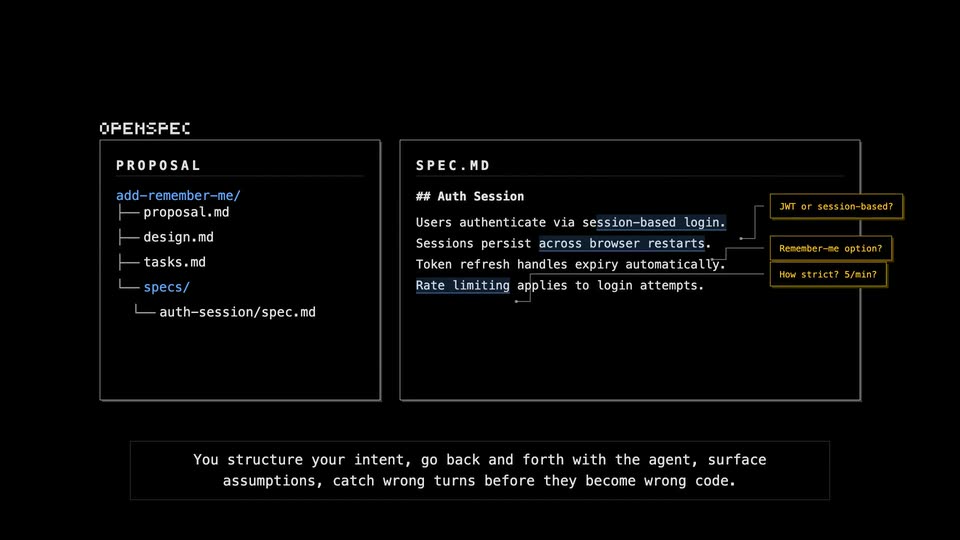
Two bordered panels open side by side on black: a file tree under PROPOSAL left, a spec document right whose lines type in one by one. Amber question callouts pop in beside highlighted phrases. A caption box restates the voiceover, then the right panel and caption exit, leaving the tree.
On-screen text: “You structure your intent, go back and forth with the agent, surface assumptions, catch wrong turns before they become wrong code.”
Techniques: Split screen, Kinetic type
Camera: Push in
A black field fills with a wireframe diagram: a PROPOSAL box with gray bars connects through an IMPLEMENT line to a central AGENT box, then four lines fan out right as AUTH FLOW, API ENDPOINTS, SESSION PERSIST and RATE LIMITING boxes appear one by one. A bottom caption fades out.
On-screen text: “Then point your agent at the spec and watch it build to the blueprint.”
Camera: Static
A black schematic links a PROPOSAL box to a central AGENT box, fanning out to four task cards on the right. The connector label flips from IMPLEMENT to VERIFY as the cards turn green with checkmarks, one flagged yellow, while a caption holds at the bottom.
On-screen text: “When it's done, use OpenSpec to verify the work against the spec.”
Camera: Static
White monospace boxes with spec names pop in one by one on black, linked by thin lines into a growing network graph. A counter bottom right ticks up to 10 specs, 42 contracts. Captions change below. The rate-limiting node expands into an amber DRIFT card.
On-screen text: “And here's what's genuinely exciting – with OpenSpec, specs don't disappear after a feature ships.”, “1 SPEC · 3 CONTRACTS”, “They compound over time.”, “A living record of what your system does and why.”, “Every new feature builds on what came before.”, “10 SPECS · 42 CONTRACTS”, “And when code drifts from the original intent – you'll know.”
Techniques: Morph
Camera: Static
Scattered feature tags joined by thin lines drift together and collapse into a bordered SPECS list with checkmarks. A bottom caption states the files work locally in version control, then is replaced by No API keys or MCP required.
On-screen text: “All of this works locally, as markdown files, checkable into version control, right alongside your codebase.”, “SPECS”, “No API keys or MCP required.”
Techniques: Morph
Camera: Static
A bordered SPECS checklist on black dims to gray as the word LBAI fades in at center. A caption box slides up at the bottom reading the voiceover line.
On-screen text: “LBAI”, “It works across over twenty different coding agents — anywhere agent skills work.”
Camera: Static
Black screen, white monospace text. The heading WORKS WITH resolves from scrambled glyphs, then twenty agent names fill in row by row with a character-scramble effect, while a bordered caption line at the bottom fades out.
On-screen text: “It works across over twenty different coding agents - anywhere agent skills work.”, “WORKS WITH”, “CLAUDE CODE”, “CURSOR”, “CODEX”, “GITHUB COPILOT”, “OPENCODE”, “WINDSURF”, “GEMINI CLI”, “ANTIGRAVITY, CLINE, ROOCODE”
Techniques: Kinetic type
Camera: Static
On a black background, a gold number counts up from 24,654 to 27,000+ in the center, with a gray GITHUB STARS label beneath it. A white caption box at the bottom carries the voiceover line, then everything fades to black.
On-screen text: “And at twenty-seven thousand stars on GitHub, we're helping define how developers work with coding agents.”, “27,000+”, “GITHUB STARS”
Techniques: Kinetic type
Camera: Static
A black screen holds a caption line at the bottom while three outlined cards type themselves in from left to right: SOLO BUILDERS, YC STARTUPS, ENTERPRISE, each with a smaller subtitle line. The cards fade out, leaving the caption alone.
On-screen text: “Loved by everyone from solo builders to Y Combinator startups to some of the largest engineering teams in the world.”, “SOLO BUILDERS”, “> INDIVIDUAL DEVELOPERS”, “YC STARTUPS”, “> EARLY-STAGE TEAMS”, “ENTERPRISE”, “> LARGE ENGINEERING ORGS”
Techniques: Kinetic type
Camera: Static
A white bar wipes in across a black screen, holds, then shrinks from the right to reveal the pixelated OPENSPEC wordmark. A small monospace caption in a thin box appears at the bottom.
On-screen text: “Check us out at openspec.dev.”
Techniques: Masking
Camera: Static
Black end card. The pixelated white OPENSPEC wordmark resolves from a glitched state, the install command types into a thin bordered box, the gray tagline decodes, and the blue openspec.dev URL appears. The composition then holds static for the rest of the clip.
On-screen text: “OPENSPEC”, “> npm i -g @fission-ai/openspec”, “A LIGHTWEIGHT SPEC-DRIVEN FRAMEWORK”, “openspec.dev”
Techniques: Kinetic type
Camera: Static