0:41

Polylane for ChatGPT · Polylane
Polylane
Design Arena · Nov 2026 · 0:40 · Code only · AI-annotated
Design Arena’s 0:40 launch film runs 8 scenes, about 5.1 s each. The product is on screen from the first frame and 2 features are revealed. There is no explicit call to action. The video is a single-voice data explainer built as a sequence of static cream slides where one serif headline stays pinned at the top while a data graphic animates below it. Signature moves are the focus-pull logo reveal, the Venn circles sliding into place, the pixel grid that smears into bars, and node-and-line trees that draw themselves; pacing is slow and even, with each idea given a full breath before the next, and the muted earth palette plus high-contrast serif type keep every frame calm
Is this your launch? to your site or press kit.
Polylane
Base44 · Apr 2026
ElevenLabs · AI · Oct 2026
A static bar chart fills a light background. A serif headline sits above a gray paragraph, then twenty vertical bars descend left to right, each capped by a circular model icon and a score, colored teal, green, orange and gray. A dashed anchor line spans the top.
On-screen text: “Human <> Intelligence Index (HII) <> Intelligence”, “Models ranked by how often real users pick their work over Claude Opus 5.5's, out of 100. As of November 22, 2026.”
Camera: Static
On a cream background, a defocused code-bracket logo and the word Intelligence snap into focus to form the headline Human <> Intelligence Index. The eyebrow INTRODUCING and a sans body line fade in, then the whole lockup slides up to make room for two new lines at the top.
On-screen text: “INTRODUCING”, “Human <> Intelligence Index”, “The world's first index to measure AI models by their impact on the human experience, as judged by millions of real users across the globe.”, “By <> Intelligence”, “Human Intelligence Index (HII) measures how AI influences the human experience.”, “From 45 sources, like the American Time Use Survey, Fast Company and Gallup Studies”
Techniques: Kinetic type
Camera: Static
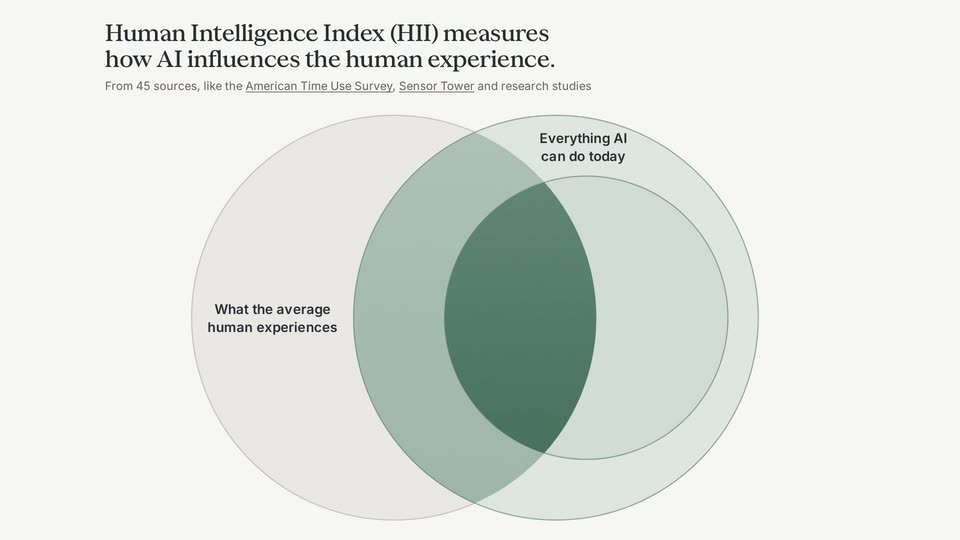
A serif headline anchors the top of a cream field. A gray circle fades in, then a green one slides in to form a Venn diagram; the dark intersection is labeled, pill tags pop in, the right circle shrinks into a nested circle, and a large 624 fills the overlap.
On-screen text: “Human Intelligence Index (HII) measures how AI influences the human experience.”, “From 45 sources, like the American Time Use Survey, Sensor Tower and research studies”, “What the average human experiences”, “Everything AI can do today”, “Where AI influences the human experience”, “Sleeping”, “Olympiad-level mathematics”, “Kernel optimizations”, “Office work”, “Content creationEducation”
Techniques: Morph
Camera: Static
On a pale gray field, a dark serif headline and a small caption sit top left. Center right, a grid of small teal, green and gold squares rotates and reflows, smearing into horizontal and diagonal bands.
On-screen text: “Human Intelligence Index (HII) measures how AI influences the human experience.”, “From 45 sources, like the American Time Use Survey, Sensor Tower and research studies”
Techniques: Particles
Camera: Static
A horizontal bar chart on a cream background sits under a serif headline. The teal, brown, green and olive bars stay fixed while their category labels and percentages fade in one row at a time, top to bottom.
On-screen text: “Human Intelligence Index (HII) measures how AI influences the human experience.”, “From 45 sources, like the American Time Use Survey, Sensor Tower and research studies”, “Phone apps 359 billion hours a year”, “58% of the index”, “Games 127 billion hours a year”, “20%”, “Web 114 billion hours a year”, “18%”, “Spreadsheets and slides 24 billion hours a year”, “4%”
Techniques: Kinetic type
Camera: Static
On a cream field, a fixed serif headline and legend sit above rows of node-and-line trees that draw themselves out, while source names and captions crossfade in the center. By the end the diagram fills with percentage labels for four domains and their tools.
On-screen text: “Weights are derived methodically from published figures.”, “Each of 4 domains and 14 leaderboards receives weights based on 222 statements. Statements are derived from 67 sources across 45 documents, leveraging 115 cal”, “Source: a published figure”, “Calculation: arithmetic on its inputs”, “Reasoning: a judgment”, “Shared: a statement used again elsewhere”, “American Time Use Survey”, “U.S. Bureau of Labor Statistics · 10 statements”, “U.S. Bureau of Labor Statistics”, “Occupation data · 1 statement”
Camera: Static
A bar chart titled Human Intelligence Index fills the frame on an off-white ground. Twenty vertical bars rise from the left, the top five in muted teal, green, olive, brown and gold, the rest in grey, each capped by a circular model icon and a score. The chart holds, then dissolves to a small centered angle-bracket mark.
On-screen text: “Human <> Intelligence Index (HII) <> Intelligence”, “Models ranked by how often real users pick their work over Claude Opus 5.5's, out of 100. As of November 22, 2026.”
Camera: Static
On a cream background, the dark serif headline fades in line by line: “Human <>” is already set while “Intelligence” and “Index” darken from light gray, and the small byline “By <> Intelligence” fades in below. The frame stays locked and the text holds.
On-screen text: “Human <> Intelligence”, “Index”, “By <> Intelligence”
Techniques: Kinetic type
Camera: Static